


Thus, we come to the conclusion that the Etude is, first of all, not a typical endgame.
The more noticeable its differences from purely theoretical endings, the more prominently it represents its specific genre, the stronger and deeper it is connected with the game, because the more fruitful the influence of the etude on the development of the combination talent of any chess player.
The more noticeable its differences from purely theoretical endings, the more prominently it represents its specific genre, the stronger and deeper it is connected with the game, because the more fruitful the influence of the etude on the development of the combination talent of any chess player.
But among the feelings that accompany chess thought, there is one that is undoubtedly the strongest and deepest - the feeling of beauty.
The beauty of a thought, which conceals a victorious force in its beauty, acts on our imagination extremely strongly and evokes a lively reaction.
This feeling triumphs even over sports excitement.
The beauty of a thought, which conceals a victorious force in its beauty, acts on our imagination extremely strongly and evokes a lively reaction.
This feeling triumphs even over sports excitement.
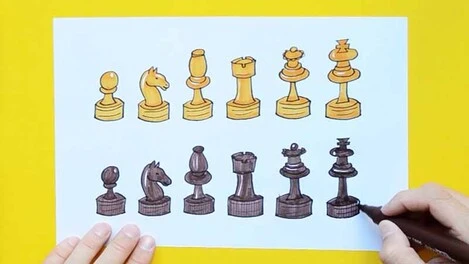
Chess pieces are distinct personalities.
Each of them has its own character, its own horizon, its own gait, its own rhythm and pace of life, its own attitude to its surrounding reality.
Some are straightforward, others are ornate; some are myopic, others are farsighted; some are fully formed characters, others with the prospect of development, growth, and qualitative rebirth (pawns).
Each of them has its own character, its own horizon, its own gait, its own rhythm and pace of life, its own attitude to its surrounding reality.
Some are straightforward, others are ornate; some are myopic, others are farsighted; some are fully formed characters, others with the prospect of development, growth, and qualitative rebirth (pawns).