



The results of the study showed that this system of tasks helps to learn not only the ways of activity and experience of creative activity, but also the emotional and value component of social experience.
...
At the same time, the acquisition of the second and third components of social experience when using the system of didactic chess tasks involves a mandatory reliance on emotional experience - the fourth, emotional and value component of social experience.
...
The ascertaining experiment helped to determine the initial stages of the development of the ability to “operate mentally” in the control and experimental groups. For this purpose, the traditional diagnostic technique of Y.A. Ponomarev “Knight and Pawns” was used.
...
To test the hypothesis of the study, at the beginning and at the end of the school year, children from the experimental groups were offered tasks on unfamiliar material.
...
The results obtained indicate that the transfer of the ability to “operate mentally” from known material to new material has been realized.
...
The development of the ability to “operate mentally” is a complex and long process, and it should begin in preschool age with the help of the leading game activity at this age.
...
One of the means that contribute to the development of children's ability to “operate mentally” is chess, or rather, the use of chess material, which also allows to use the developmental potential of many other intellectual games.
...
The optimal organizational form of conducting chess classes for the development of the ability to act in the “mind” - “task” - is determined.
...
The effectiveness of the developed system under the above conditions was tested on experimental groups of children (compared to control groups).
...
The hypothesis of the study was confirmed on unfamiliar material for children. The results obtained indicate that the ability to “operate mentally” was transferred from known material to new material.
...
At the same time, the acquisition of the second and third components of social experience when using the system of didactic chess tasks involves a mandatory reliance on emotional experience - the fourth, emotional and value component of social experience.
...
The ascertaining experiment helped to determine the initial stages of the development of the ability to “operate mentally” in the control and experimental groups. For this purpose, the traditional diagnostic technique of Y.A. Ponomarev “Knight and Pawns” was used.
...
To test the hypothesis of the study, at the beginning and at the end of the school year, children from the experimental groups were offered tasks on unfamiliar material.
...
The results obtained indicate that the transfer of the ability to “operate mentally” from known material to new material has been realized.
...
The development of the ability to “operate mentally” is a complex and long process, and it should begin in preschool age with the help of the leading game activity at this age.
...
One of the means that contribute to the development of children's ability to “operate mentally” is chess, or rather, the use of chess material, which also allows to use the developmental potential of many other intellectual games.
...
The optimal organizational form of conducting chess classes for the development of the ability to act in the “mind” - “task” - is determined.
...
The effectiveness of the developed system under the above conditions was tested on experimental groups of children (compared to control groups).
...
The hypothesis of the study was confirmed on unfamiliar material for children. The results obtained indicate that the ability to “operate mentally” was transferred from known material to new material.
Under the ability to "operate mentally" we will understand a preschool age neoplasm, an integrated characteristic of human consciousness, which is an inseparable unity of imagination, attention, memory and thinking and consists in the ability of an individual to operate in the mental plane with substitutes for real objects (without performing detailed operations with them in space).
...
As it has become clear in recent years, the development of the ability to "operate mentally" and the peculiarities of assimilating social experience are interrelated processes.
...
A preschooler learns social experience primarily through the leading type of activity for this age - play.
...
The success of mastering these learning activities suggests that all children from the first days of school have already developed the ability to "operate mentally" to the necessary extent, but in fact this is not the case.
...
It is proved that the ability to "operate mentally" must be specially “stretched”, and its development is a slow process that involves a long mental education of the child and ends at about twelve years of age.
...
The main attention was paid to didactic games - games whose structural components are: didactic task, game task, game actions, game rules, its content, result and didactic material.
...
Among the favorable conditions for the development of the ability to "operate mentally", researchers distinguish the solution of theoretical problems, modeling, gradual development of the ability to "operate mentally", group work, oral work.
...
As a result, it was concluded that from the content point of view, the “task” form of classes was optimal.
...
Only that social experience can be assimilated by a preschooler that will most affect the sphere of his emotions and feelings.
...
As it has become clear in recent years, the development of the ability to "operate mentally" and the peculiarities of assimilating social experience are interrelated processes.
...
A preschooler learns social experience primarily through the leading type of activity for this age - play.
...
The success of mastering these learning activities suggests that all children from the first days of school have already developed the ability to "operate mentally" to the necessary extent, but in fact this is not the case.
...
It is proved that the ability to "operate mentally" must be specially “stretched”, and its development is a slow process that involves a long mental education of the child and ends at about twelve years of age.
...
The main attention was paid to didactic games - games whose structural components are: didactic task, game task, game actions, game rules, its content, result and didactic material.
...
Among the favorable conditions for the development of the ability to "operate mentally", researchers distinguish the solution of theoretical problems, modeling, gradual development of the ability to "operate mentally", group work, oral work.
...
As a result, it was concluded that from the content point of view, the “task” form of classes was optimal.
...
Only that social experience can be assimilated by a preschooler that will most affect the sphere of his emotions and feelings.
The successful implementation of priority tasks is associated with the transfer of social experience to a new generation, which includes knowledge, ways of doing things, experience of creative activity, and experience of emotional and value-based attitudes towards the world.
...
Research shows that a significant number of children who come to school are characterized by age-related unformed school functions: organization of activity, attention, memory, thinking, and speech.
...
Experts believe that it is necessary not to accelerate the development of preschoolers, but to enrich it, using the leading game activity at this age.
...
At the same time, in recent years, many researchers have noted that preschoolers' play activities are underdeveloped, children play little and are poorly able to obey the rules.
...
One of such important indicators is the ability to "operate mentally", studied by Y.O. Ponomarev.
...
The purpose of his research was to find an answer to the question: does any intellectual ability develop during learning that is not limited to the mere accumulation of knowledge and skills?
...
And the answer was yes, and this is the ability to "operate mentally".
...
This ability was designated as one of the universal characteristics of human consciousness, one of the most important indicators of the overall development of the human psyche, which does not belong to any of the traditionally distinguished mental processes, but is an inseparable unity of imagination, attention, memory and thinking.
...
Chess is one of these tools.
...
In our opinion, chess is of no less value for preschool education, due to the important role it can play in the process of internalization.
...
We are not talking about playing chess as such, where the ability to "operate mentally" is formed spontaneously, but about developing a system of didactic chess tasks designed to develop this ability.
...
At the same time, chess tasks mean tasks using chess material, which makes it possible to use the developmental potential of many other intellectual games.
...
The importance of the problem of purposeful development of the ability to "operate mentally" in preschoolers through the use of chess material and its insufficient development in pedagogical science have determined the relevance of the chosen research topic.
...
Research shows that a significant number of children who come to school are characterized by age-related unformed school functions: organization of activity, attention, memory, thinking, and speech.
...
Experts believe that it is necessary not to accelerate the development of preschoolers, but to enrich it, using the leading game activity at this age.
...
At the same time, in recent years, many researchers have noted that preschoolers' play activities are underdeveloped, children play little and are poorly able to obey the rules.
...
One of such important indicators is the ability to "operate mentally", studied by Y.O. Ponomarev.
...
The purpose of his research was to find an answer to the question: does any intellectual ability develop during learning that is not limited to the mere accumulation of knowledge and skills?
...
And the answer was yes, and this is the ability to "operate mentally".
...
This ability was designated as one of the universal characteristics of human consciousness, one of the most important indicators of the overall development of the human psyche, which does not belong to any of the traditionally distinguished mental processes, but is an inseparable unity of imagination, attention, memory and thinking.
...
Chess is one of these tools.
...
In our opinion, chess is of no less value for preschool education, due to the important role it can play in the process of internalization.
...
We are not talking about playing chess as such, where the ability to "operate mentally" is formed spontaneously, but about developing a system of didactic chess tasks designed to develop this ability.
...
At the same time, chess tasks mean tasks using chess material, which makes it possible to use the developmental potential of many other intellectual games.
...
The importance of the problem of purposeful development of the ability to "operate mentally" in preschoolers through the use of chess material and its insufficient development in pedagogical science have determined the relevance of the chosen research topic.

First, a brief excursion into epistemology. How does knowledge arise? Its source is the data of the senses.
...
A relevant question is: where is the guarantee that our imagination will give birth to the concept we are looking for, and not some nonsense?
...
Kant saw an active beginning in the intellect, but could not do so with respect to sense cognition.
....
In fact, the philosophical doctrine of unconscious thinking originates from Leibniz.
...
Thinking uncontrolled by the mind attracted Kant's close attention.
...
Human culture, according to Freud, is a system of prohibitions that are layered and complicated in the course of history.
...
Like Pavlov, Einstein highly appreciated the theory of displacement.
...
The study of dreams is one of the ways leading to the analysis of creative imagination.
...
Firstly, a dream strikes with its incoherence, absurdity, and accumulation of absurdities.
...
According to Brecht, the purpose of the dream is to bring out of the “automaticity of perception”, to look at the ordinary with an unusual look, to see something strange, new in it, to make you think, to teach you to think.
...
Finally, the “illusion of correctness,” the desire to clarify, explain the confusion caused by allegory, ambiguity, and a visual representation of an abstract thought.
...
in the West, at the faculties of science and technology, the compulsory curriculum in recent years has increasingly included general humanities and special artistic disciplines, and during competitions for scientific and technical positions in some companies and institutions, the applicant's artistic culture is tested, not just his knowledge, but his ability to interpret works of contemporary art.
...
A relevant question is: where is the guarantee that our imagination will give birth to the concept we are looking for, and not some nonsense?
...
Kant saw an active beginning in the intellect, but could not do so with respect to sense cognition.
....
In fact, the philosophical doctrine of unconscious thinking originates from Leibniz.
...
Thinking uncontrolled by the mind attracted Kant's close attention.
...
Human culture, according to Freud, is a system of prohibitions that are layered and complicated in the course of history.
...
Like Pavlov, Einstein highly appreciated the theory of displacement.
...
The study of dreams is one of the ways leading to the analysis of creative imagination.
...
Firstly, a dream strikes with its incoherence, absurdity, and accumulation of absurdities.
...
According to Brecht, the purpose of the dream is to bring out of the “automaticity of perception”, to look at the ordinary with an unusual look, to see something strange, new in it, to make you think, to teach you to think.
...
Finally, the “illusion of correctness,” the desire to clarify, explain the confusion caused by allegory, ambiguity, and a visual representation of an abstract thought.
...
in the West, at the faculties of science and technology, the compulsory curriculum in recent years has increasingly included general humanities and special artistic disciplines, and during competitions for scientific and technical positions in some companies and institutions, the applicant's artistic culture is tested, not just his knowledge, but his ability to interpret works of contemporary art.

Among the problems that attract the attention of modern heuristics, two are the least developed: the unconscious components of the researcher's psyche and the aesthetic principle in his thinking.
...
The starting point of reasoning is the idea of a number of authors about the four stages of the process of invention (scientific discovery)
...
The work involves a completely different type of thinking, not the usual one, which is associated with a clearly fixed sign system adapted to the needs of communication.
...
To create means to make a choice, rejecting unsuitable options, and the unconscious choice is guided by a sense of scientific beauty
...
A special aesthetic sense is a kind of sieve that lets through what can be true because of its harmony.
...
Creativity is a creation in beauty. In other words, any creative act is inherently aesthetic.
...
Beauty, therefore, is not in knowledge itself, but in its acquisition, in its proof, in the discovery of unity where it could only be assumed.
...
In clarifying the points of contact between the heuristic situation in science and artistic activity, one should also take into account the critically interpreted Kantian definition of beauty as a “game of cognitive abilities.”
...
As for playful behavior, it exists in two forms (competition and imitation), which sometimes merge together.
...
A person seeks to achieve some result consciously “programmed” during the competition, and then surpass it.
...
Even more important for our problem is the second hypostasis of the game - imitation.
...
The pioneer lives in two spheres: the existing one reminds of itself all the time, but the sought-after one is perceived with a due measure of reality.
...
The starting point of reasoning is the idea of a number of authors about the four stages of the process of invention (scientific discovery)
...
The work involves a completely different type of thinking, not the usual one, which is associated with a clearly fixed sign system adapted to the needs of communication.
...
To create means to make a choice, rejecting unsuitable options, and the unconscious choice is guided by a sense of scientific beauty
...
A special aesthetic sense is a kind of sieve that lets through what can be true because of its harmony.
...
Creativity is a creation in beauty. In other words, any creative act is inherently aesthetic.
...
Beauty, therefore, is not in knowledge itself, but in its acquisition, in its proof, in the discovery of unity where it could only be assumed.
...
In clarifying the points of contact between the heuristic situation in science and artistic activity, one should also take into account the critically interpreted Kantian definition of beauty as a “game of cognitive abilities.”
...
As for playful behavior, it exists in two forms (competition and imitation), which sometimes merge together.
...
A person seeks to achieve some result consciously “programmed” during the competition, and then surpass it.
...
Even more important for our problem is the second hypostasis of the game - imitation.
...
The pioneer lives in two spheres: the existing one reminds of itself all the time, but the sought-after one is perceived with a due measure of reality.

Great commanders used to say historical phrases before decisive battles: "The die is cast," said Caesar, crossing the Rubicon.
...
And then almost mysticism began.
...
What is the main reason for the blunder? In the wrong assessment of the position. It was a completely justified bias born of the developments in the party.
...
It is clear that these considerations made him look for a win. He did not find it. But there must be one! And then he took the random option as the one he was looking for.
...
This ancient problem has been facing people for hundreds of years, no matter what kind of activity they are engaged in. For the study of blunders, we are interested in only one aspect of this problem.
...
We have examined only three types of blunder: the dominance of general considerations, pinned pieces, and the order of calculation. There are many more. Each case has its own recipe: in the first case, imagine the final position in your mind, in the second, "keep an eye on" the linkage all the time. And what about the third?
...
All the world champions have been "blundered", but it didn't stop them from becoming champions. So it's best to try to learn how to play like them.
...
And then almost mysticism began.
...
What is the main reason for the blunder? In the wrong assessment of the position. It was a completely justified bias born of the developments in the party.
...
It is clear that these considerations made him look for a win. He did not find it. But there must be one! And then he took the random option as the one he was looking for.
...
This ancient problem has been facing people for hundreds of years, no matter what kind of activity they are engaged in. For the study of blunders, we are interested in only one aspect of this problem.
...
We have examined only three types of blunder: the dominance of general considerations, pinned pieces, and the order of calculation. There are many more. Each case has its own recipe: in the first case, imagine the final position in your mind, in the second, "keep an eye on" the linkage all the time. And what about the third?
...
All the world champions have been "blundered", but it didn't stop them from becoming champions. So it's best to try to learn how to play like them.
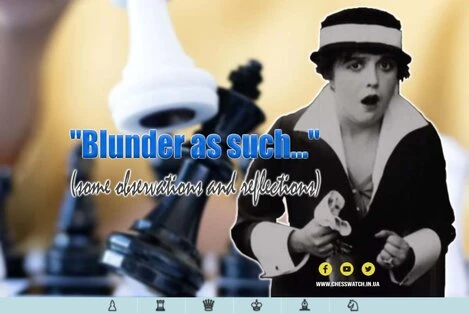
A chess player will never ask: "Why did you blunder?". He will ask neither his interlocutor nor himself.
...
Mistakes in chess can be divided into three types.
...
There is only one way out: to learn to play better.
...
Strictly speaking, a chess player's creative process consists of only two mental operations: calculating a variation and evaluating a position.
...
A chess player's thinking is subject to strict discipline. He is forced to save time and effort, he cannot afford to count everything he wants.
...
Here's a rule that can help you avoid such gaps: after calculating a variation, imagine the position that arose at the end of the calculation.
...
And these relationships - even between your own pieces - are often quite strained. The whole game is, in fact, a process of clarifying relationships.
...
Sometimes both opponents make connections.
...
Mistakes in chess can be divided into three types.
...
There is only one way out: to learn to play better.
...
Strictly speaking, a chess player's creative process consists of only two mental operations: calculating a variation and evaluating a position.
...
A chess player's thinking is subject to strict discipline. He is forced to save time and effort, he cannot afford to count everything he wants.
...
Here's a rule that can help you avoid such gaps: after calculating a variation, imagine the position that arose at the end of the calculation.
...
And these relationships - even between your own pieces - are often quite strained. The whole game is, in fact, a process of clarifying relationships.
...
Sometimes both opponents make connections.
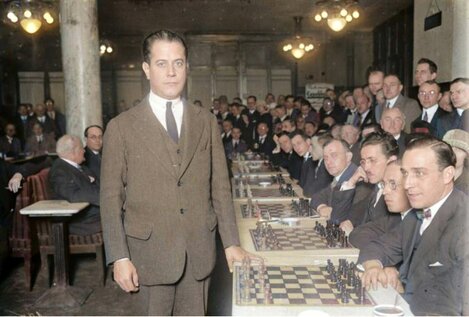
Here are the main conclusions of the analysis:
1. Debut: X. R. Capablanca's highly developed intuition in choosing reliable and practically feasible continuations has been identified...
2.Mittelspiel: It relies mainly on quick intuitive assessment of the situation. This results in speed and ease of play despite a noticeable lack of critical thinking...
3.Endgame: X. R. Capablanca demonstrates noticeably high technical skill in this phase of the game, but he plays relatively weaker...
1. Debut: X. R. Capablanca's highly developed intuition in choosing reliable and practically feasible continuations has been identified...
2.Mittelspiel: It relies mainly on quick intuitive assessment of the situation. This results in speed and ease of play despite a noticeable lack of critical thinking...
3.Endgame: X. R. Capablanca demonstrates noticeably high technical skill in this phase of the game, but he plays relatively weaker...
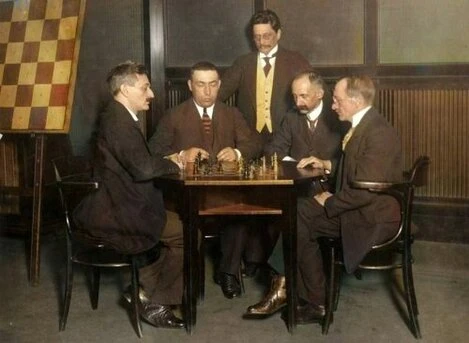
Em. Lasker was the first of the great chess players to realize the importance of studying the personality of opponents in chess.
Em. Lasker repeatedly pointed out that "people fight on chessboards, not wooden pieces".
Em. Lasker repeatedly pointed out that "people fight on chessboards, not wooden pieces".
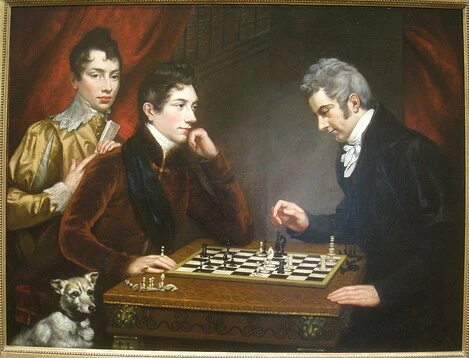
Further, the intermediate operation of calculation - a move in the mind - involves fixing the position resulting from the move with the visual imagination.
It is quite obvious that such a visual fixation of the change made by the move is absolutely necessary so that when thinking about further moves, the figure moving in the mind is already in the right place.
It is quite obvious that such a visual fixation of the change made by the move is absolutely necessary so that when thinking about further moves, the figure moving in the mind is already in the right place.