


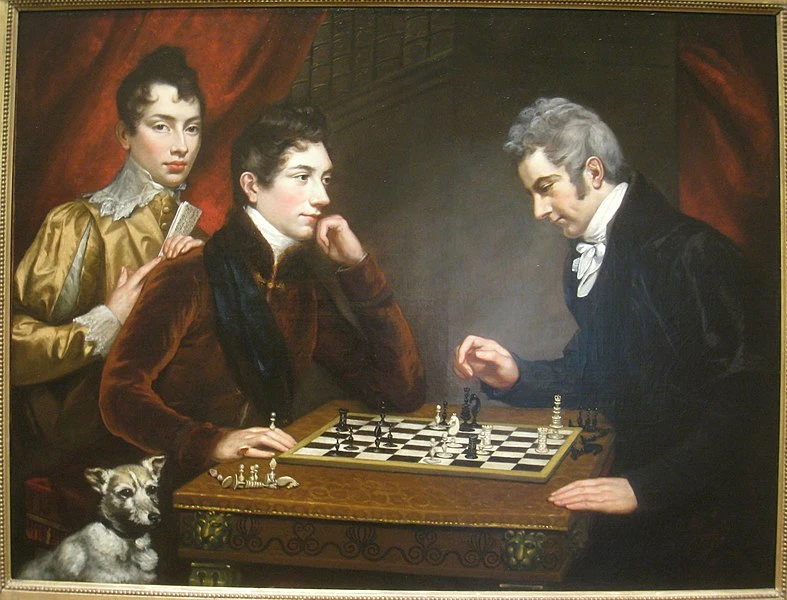
Further, the intermediate operation of calculation - a move in the mind - involves fixing the position resulting from the move with the visual imagination.
It is quite obvious that such a visual fixation of the change made by the move is absolutely necessary so that when thinking about further moves, the figure moving in the mind is already in the right place.
It is quite obvious that such a visual fixation of the change made by the move is absolutely necessary so that when thinking about further moves, the figure moving in the mind is already in the right place.
A combination is born in the chess player's head.
Many thoughts strive for realization - correct and erroneous, strong and weak, practical and impractical.
They are born and fight with each other until one of them prevails.
Many thoughts strive for realization - correct and erroneous, strong and weak, practical and impractical.
They are born and fight with each other until one of them prevails.
The alphabet of the game is its rules: the goal of the game (checkmate), the turn-taking, the rules of the movement of the pieces, and so on.
All these techniques are consciously learned, but over time, the process of applying them becomes automated.
This manifests itself in the fact that the board and the pieces are perceived unconsciously as spatial, dynamic, and meaningful relationships according to the rules of the game, and this transformation of visual impressions into meaningful relationships occurs with unusual speed, so the intermediate links in the process usually become inaccessible to self-observation.
All these techniques are consciously learned, but over time, the process of applying them becomes automated.
This manifests itself in the fact that the board and the pieces are perceived unconsciously as spatial, dynamic, and meaningful relationships according to the rules of the game, and this transformation of visual impressions into meaningful relationships occurs with unusual speed, so the intermediate links in the process usually become inaccessible to self-observation.
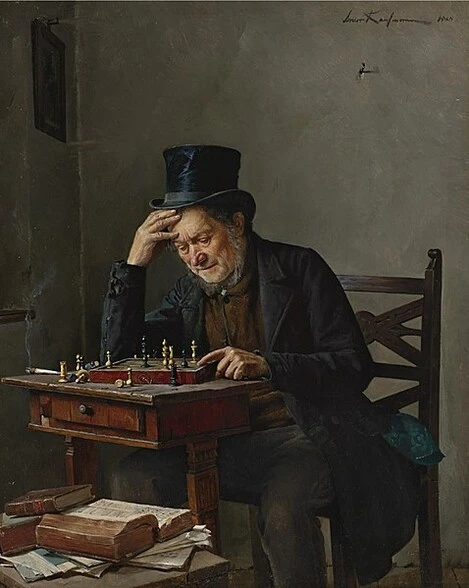
The thinking of a chess player is also characterized by visual perception: it is related to the visual perception of the board, the pieces on the board, and the spatial relationships between them, as well as with visual images created by the imagination during the thought process of moving the pieces.
It happens to every chess player that, having calculated the correct option, he cannot decide whether it is profitable or not, which, as far as I can tell from myself, is primarily due to the lack of clarity of the picture that has arisen in his mind. A chess player's thought is connected with visual representations. Therefore, the clearer and more vivid the visual picture, the easier and more accurate the thought works and the richer it is.