



Great commanders used to say historical phrases before decisive battles: "The die is cast," said Caesar, crossing the Rubicon.
...
And then almost mysticism began.
...
What is the main reason for the blunder? In the wrong assessment of the position. It was a completely justified bias born of the developments in the party.
...
It is clear that these considerations made him look for a win. He did not find it. But there must be one! And then he took the random option as the one he was looking for.
...
This ancient problem has been facing people for hundreds of years, no matter what kind of activity they are engaged in. For the study of blunders, we are interested in only one aspect of this problem.
...
We have examined only three types of blunder: the dominance of general considerations, pinned pieces, and the order of calculation. There are many more. Each case has its own recipe: in the first case, imagine the final position in your mind, in the second, "keep an eye on" the linkage all the time. And what about the third?
...
All the world champions have been "blundered", but it didn't stop them from becoming champions. So it's best to try to learn how to play like them.
...
And then almost mysticism began.
...
What is the main reason for the blunder? In the wrong assessment of the position. It was a completely justified bias born of the developments in the party.
...
It is clear that these considerations made him look for a win. He did not find it. But there must be one! And then he took the random option as the one he was looking for.
...
This ancient problem has been facing people for hundreds of years, no matter what kind of activity they are engaged in. For the study of blunders, we are interested in only one aspect of this problem.
...
We have examined only three types of blunder: the dominance of general considerations, pinned pieces, and the order of calculation. There are many more. Each case has its own recipe: in the first case, imagine the final position in your mind, in the second, "keep an eye on" the linkage all the time. And what about the third?
...
All the world champions have been "blundered", but it didn't stop them from becoming champions. So it's best to try to learn how to play like them.
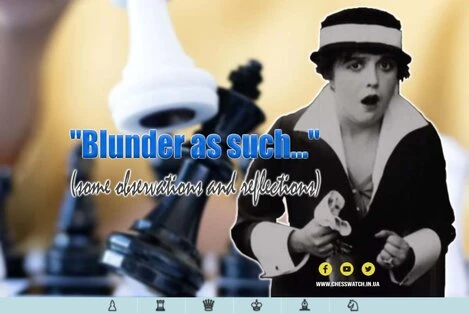
A chess player will never ask: "Why did you blunder?". He will ask neither his interlocutor nor himself.
...
Mistakes in chess can be divided into three types.
...
There is only one way out: to learn to play better.
...
Strictly speaking, a chess player's creative process consists of only two mental operations: calculating a variation and evaluating a position.
...
A chess player's thinking is subject to strict discipline. He is forced to save time and effort, he cannot afford to count everything he wants.
...
Here's a rule that can help you avoid such gaps: after calculating a variation, imagine the position that arose at the end of the calculation.
...
And these relationships - even between your own pieces - are often quite strained. The whole game is, in fact, a process of clarifying relationships.
...
Sometimes both opponents make connections.
...
Mistakes in chess can be divided into three types.
...
There is only one way out: to learn to play better.
...
Strictly speaking, a chess player's creative process consists of only two mental operations: calculating a variation and evaluating a position.
...
A chess player's thinking is subject to strict discipline. He is forced to save time and effort, he cannot afford to count everything he wants.
...
Here's a rule that can help you avoid such gaps: after calculating a variation, imagine the position that arose at the end of the calculation.
...
And these relationships - even between your own pieces - are often quite strained. The whole game is, in fact, a process of clarifying relationships.
...
Sometimes both opponents make connections.